

Search this journal

Search by title, author, DOI or keyword.

Search Results

4 articles

Hybrid Bio-Inorganic Materials for Environmental Remediation

Sher Wali Khan, Rifhat Bibi

New Environmentally-Friendly Materials · 73-88 · 10.55121/nefm.v2i1.858

Environmental pollution from heavy metals, persistent organic compounds, and emerging contaminants poses a growing threat to ecosystems and human health. Remediation processes have typically been associated with high costs, low selectivity, and secondary wastes, prompting a search for greener solutions. Mixed into renewable biop
Read article →↓ PDF Cite923 views602 downloads

Sawdust as an Environmentally Friendly Adsorbent

Muhammad Anis Aslam, Idrees Khan

New Environmentally-Friendly Materials · 83-101 · 10.55121/nefm.v1i1.862

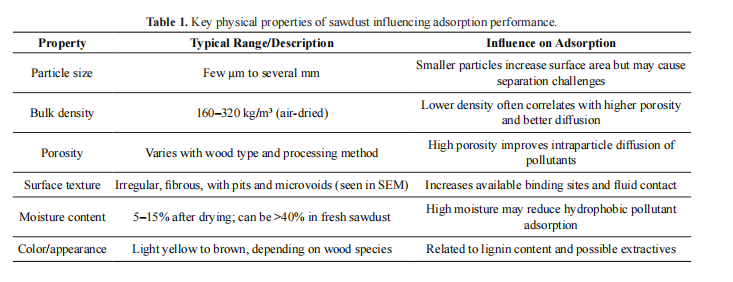
Sawdust, an abundant byproduct of the wood processing industry, has gained attention as a sustainable, low-cost adsorbent for water and wastewater treatment. Its lignocellulosic composition—rich in cellulose, hemicellulose, and lignin—provides a variety of functional groups capable of binding a wide range of contaminants, includ

Graphical abstract for Sawdust as an Environmentally Friendly Adsorbent
Read article →↓ PDF Cite1,576 views865 downloads

Investigation on Ficus carica and Punica granatum Extracts as Eco-Friendly Corrosion Inhibitors for C1018 Carbon Steel in Acidic and Marine Environments

Abdlmanam S. A. Elmaryami, Omar Nashed, Mahmoulah Y. Abdulraheem, Abdul Hamid Omran Saleh, Salah Mohamed Sallab, Garrett Arciete, Rahel G. Rahel

New Environmentally-Friendly Materials · 27-39 · 10.55121/nefm.v5i1.1249

This study evaluates the corrosion behavior of carbon steel in acidic medium and seawater in the presence of natural plant extracts derived from pomegranate peels and fig leaves as environmentally friendly corrosion inhibitors. The weight loss technique was employed to determine the corrosion rate and inhibition efficiency after

Read article →↓ PDF Cite748 views611 downloads

A Proof of Concept Zinc-Mediated RDRP of Alanine Acrylamide for Efficient Dye Encapsulation to Clean the Wastewater for Green Environment

Subrata Dolui

New Environmentally-Friendly Materials · 34-40 · 10.55121/nefm.v3i1.297

A PH-responsive synthetic biohybrid biohybrid module poly (L-alanine acrylamide)-blockpoly(methylmethacrylate (PAAla-b-PMMA) diblock biohybrids, based on hydrophilic PAAla and hydrophobic PMAA segments, is developed via direct switching from Zinc (Zn) catalyst polymerization. EbiB was used as an initiator to Zn-mediate Reversibl

Read article →↓ PDF Cite975 views533 downloads